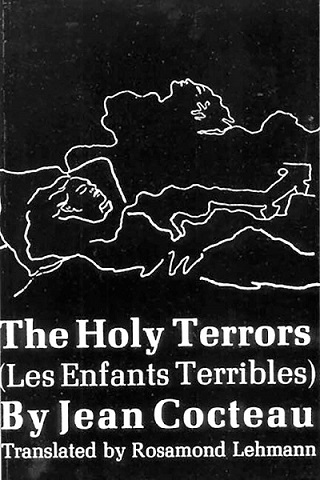
I had no preconceived expectation from a book originally published in French in 1929, but much to my delight, found this to be outstanding read. I stumbled upon this after searching the authors name; Jean Cocteau, as he was referenced in The Cloud of Unknowing by Thomas Cook. The reference was obscure and due to TCoU being fiction and unsuccessfully looking up some of the other references, coming to find they were fiction and only created for the story, I continued to search the library app and The Holy Terrors was the first result.
In reading this book, I felt as though I was reading poetry tangled in a story. This is a type ‘classic’ literature, a deeply penetrating, raw and visceral read that I am not yet accustom to reading, but looking forward to becoming lost within.
I started to jot down some of my favorite imagery and quotes, but soon came to realize that I would just end up copying the entire book, so even before finishing the library copy, I had ordered my own from eBay.
Below are only a handful of the shorter sections I have copied, from only the first half of the book. My intention by providing these snippets is only to give a sense of how this is written and to encourage the reading of this work.
- …with something in his attitude… in the kind of attitude that seems to warn the frivolous spectator to keep his distance
- spite had prompted him to perpetrate an act of malice and injustice
- the door opened wide to reveal a girl of sixteen, with a strong physical resemblance to Paul (her brother). She had the same blue eyes, shadowed by dark lashes, the same pallor of complexion. But where as the lines of his face betrayed a certain weakness by comparison, hers, two years older, beneath soft curling hair, had already ceased to be sketched for the finished prostate, was already groping for its organic principle and racing, disheveled, to overtake its final beauty.
- snatching them acrimoniously from one another, devouring them with gluttonous indiscretion, aiming to reach satiety, revulsion…
- thus, one day he came upon these words, printed in soap upon the mirror: “suicide is a mortal sin”. Clamorous affirmation, stamped indelibly, but no doubt assumed by the children to be no more visible than a scrawl in the water, the slogan – symbolic equivalent, no doubt, of the mustache that decked the bust- bore witness to some rare lyric mood whose secret none might share
This book is set in a Part One and Part Two, both with very distinct writing styles, almost as though they written in part by two different people, with the same writing style, nearly seamlessly stitched together. While the first half being lighthearted and full of silver linings, to highlight the innocence of childhood, the second half is focused on dealing with the consequences of puzzle pieces set in motion from long ago. I was worried that this read was going to become too dark, as it could have easily slipped far down that road, as there were many opportunities to do so, but this was never the case, and I was saddened to finish this read.
I would encourage the reading of this work, as I enjoyed this very much; even the words I was unfamiliar with and found myself in need of looking up.
 Perspective is key