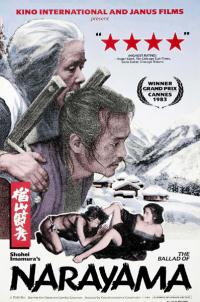
I ran across this film as I was listing to Jordan Petersons Podcast “Primatologist Explains the 1% Difference Between Humans & Apes” in the background while working. They discussed how language and communication in humans circumvent the Alpha male characteristic and how no other species has this capability.
In their discussion, they made reference to The Ballad of Narayama, which was described as the documentation of the lives of isolated villages in Japan, where there was a family in the village who consistently broke the rules and pilfered food, and all of the villages conspired together as a consequence and in the night, crept into their house and killed all of them. At the end, two men carried their aged parents off to a mountain to abandon them, which is the typically way to deal with elders in this village and one woman goes voluntarily and the other man fights and struggles.
After hearing this kind of endorsement I searched Amazon and found that I could rent it for $3. I then searched the Library app and found that I could transfer this film to my branch location for free. I mention as I highly recommend that you take advantage of your public library if you do not already do so. There are so many resources available for free!
This film begins in a small Japanese village in the mountains, where life is primitive and dreadfully difficult. In this village they have a tradition when you reach the advanced age of 70, you are exiled to a remote mountain to die of starvation, in an effort to relieve the burden of your aging self from your family and community as a whole. This sacrifice is seen a noble and honorable thing to do, and is knit into the fabric of their community.
This story circle around a 69 year old mother, and the tasks she undergoes in preparation for her final journey. She spends her remaining time to tie up loose ends for her family and has the foresight to make controversial decisions knowing the outcome would not be initially accepted. As noted in the intro, there is a family in the village which has been stealing and hording food. As the other villages become wise to this, they conspire to confront the family by breaking down their door at night, and rummaging their house for evidence, which they indeed find. One of the mothers sons has a relationship with the daughter of the thieving house and is now pregnant. Knowing the history of the family the pregnant daughter comes from and now with the confirmation that the village knows they are thieves, she sends the girl with food, home to her family on the night the village has planned to extinguish the blood line, which she is no exception to their fate.
This scene in particular sparked debate in my family room as I could “place” myself in that time and place and see how this would be a necessary punishment, while other people in my company did not share my view. This is how the world was, this was the necessary course of action to prevent stealing, in small close knit communities.
The ending of the movie was very emotional, I once again placed myself in the time and place and envisioned carrying my own mother up a mountain to leave here there to die. While the mother in the movie went willingly, as she believed that this was the best sacrifice she could make to ensure the survival of her family, others taken to the mountain were not so willing.
This makes me remember that normal is only normal because that is what we are use to. In this time and place, this was the normal thing to do. Killing an entire family; women and children included, was the normal thing to do and was accepted within all of the community. Looking back hundreds of years, its easy to pass judgment, but I could not imagine living that kind of life, planting crops in the field, working all day with out knowing if we would have enough food to make it through the winter. We are really living in the best time of all human history. Thinking on this further, they struggle their whole lives, trying to survive, and finally when you have the wisdom to survive, they are sent to die. They lived their while lives trying to survive, and then die, how much different are we a few hundred years later I wonder…
 Perspective is key