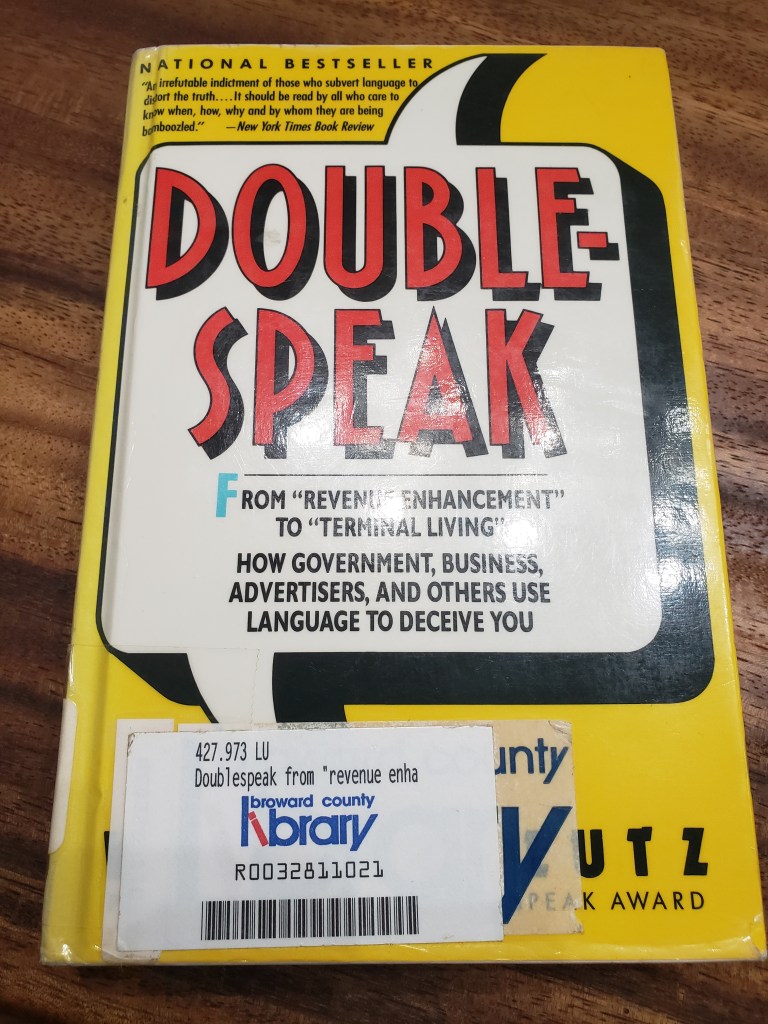
This book was written in 1989 which highlights the deceptive language used, mostly by corporations, advertising agencies and governments to deceive the general public. As this book was written more than 30 years ago, some of the references seem outdated and I can only imagine how things have progressed into our current time that we are just not aware of.
While reading this book, I was keenly aware that the intent of this was to educate people into not being deceived by this type of language, but I read this as almost an instruction manual; for the language I should use in my career. Some of the deceptive terms littered throughout the, almost overwhelming quantity of examples, are so common place, I do not even perceive them as double speak as this is now my day to day in a corporate setting.
Below are some of my more noteworthy quotes and takeaways:
(n) dou·ble·speak: language that conceals or prevents thought; rather than extending thought, doublespeak limits it.
- xi: The issue is not what we are doing to the language, but what we are doing with the language.
- p53: if anyone can understand it, then it cant be very special.
- p74: Television becomes the norm against which everything else in society is measured
- p79: Advertising and Reality: Our problem is [Advertising firm] – a client comes into my office and throws two newly minted half dollars onto my desk and says, “min is the one of the left. You prove its better.”
- p169: When war isn’t war: Until 1974 we had “The Department of War”. President Harry S Truman signed the National Security Act of 1974 to eliminate The Department of War to The Department of Defense Thus “war” because “defense”…. Now we can spend hundreds of billions of dollars for “defense” not war…. In 1982 the “defense” budget was “the most important social welfare program for which the federal government must be responsible” which sounds a whole lot better than saying the war budget is the most important social welfare program for which the federal government must be responsible.
- p173: “outside of the current accuracy requirements” aka missed. (missile missing targets)
- p179: War is fought by solders who are corporate employees working to advance the goals of their employer.
- p195: …A voter became upset when the candidate for whom he voted for promptly, once in office, ignored all of the promises he made during the campaign. He sued the politician for breach of oral contract…. In new York the judge ruled “a contract cannot be based on an ante-election promise to voters generally by a candidate for public office, so as to give the voter a right to restrain the promiser rom violating the same.” In other words, there is no legal way voters can make politicians keep their promises, once they have been elected, so politicians are free to say what ever they want during an election, and then do what every they want once they are in office. (O’Reilly v. Mitchell, ’85 Misc. 176, 148 N.Y.S. 88 [Sup. Ct. 1914].)
- p226: Bribes are just “Tips” or “Payments to facilitate non-discretionary administrative action”
While I did find many of the examples repetitive and some chapters long winded, I do not regret the time to read this. In July of 2022 (at the time of this post) our government has taken the liberty to redefine that a ‘recession’ is, to fit a specific narrative, which falls right in line with the timing of me reading this book.
The Department of Defense and the Pentagon chapters were my very enlightening chapters. You get a history of the names of things of common things we know now and how they have been renamed with the intention of concealing the true nature of the world, which successfully happened.
I learned of many tricks which are employed by advertising companies, specifically in regards to how our food is labeled, or rather mislabeled. I would suggest that you educate yourself of this topic in particular. How different ingredients are concealed, how things are intentionally miss labeled to mislead, the food you think you are eating is NOT what you think it is.
If you do not have time to read the book, I would suggest you look up some of the videos, as the author can give a better summary that I could, but this is worth spending some time on. https://www.c-span.org/video/?10449-1/doublespeak
Thank you for taking the time to read this post, I would welcome any feedback which you may have.
 Perspective is key