You can use this link to view Barry’s Ted Talk in which he summarizes his book.
Learning to choose is hard. Learning to choose well is harder. And learning to choose well in a world of unlimited possibilities is harder still, perhaps too hard. – Barry Schwartz
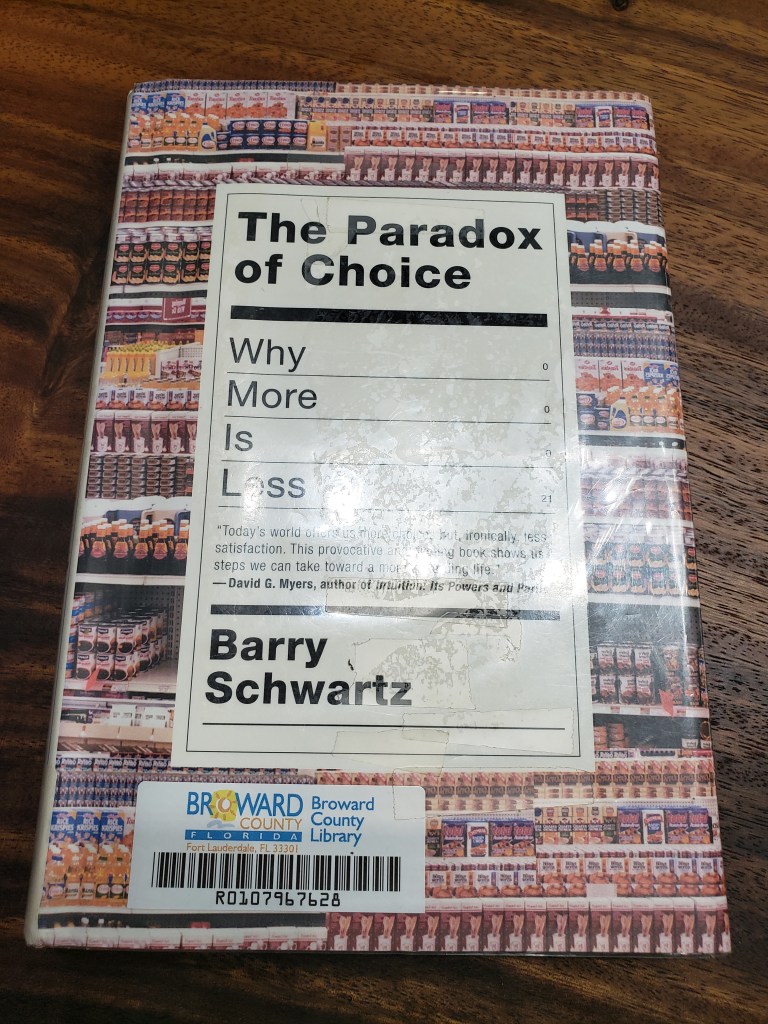
The Paradox of Choice explains how the more we have to choose from, the less satisfied we end up feeling due to psychologic paradox of choice and regret which in many cases contribute to depression and suicide.
Everything sufferers from comparison, yet this in itself is the key to avoid the suffering. I believe everything is a choice and you get to choose the perspective you use to asses the world around you. You can choose to look at the good, which does not make the bad vanish, but there is always good to be found in every situation, even if it is not apparent to you immediately.
Many studies are referenced, my favorite of which is; when individual participants were paired up with other participants, then individually offered to receive $50 where their partner would receive $25, OR they could receive $100 and their partner in the study would receive $200, the participants were more likely to choose $50/$25, as by comparison, they would be better off. I initially scoffed that this example, thinking to myself, who would choose half as much to take home, but still curious, I asked my 9 year old, who happened to be near. She immediately responded that she would take the $50/$25 split, even after I confirmed that she was aware that she would get more money if she took the $100. In this example, she did not find in fair that the other person would get more money, and this was the basis of her decision. The book goes on to explain that people would rather be the big fish in the small pond, even if that means they get less, as long as it is more by comparison, as this is an ingrained survival mechanism.
Below are some of my notes and quotes from this read:
- p2 – When people have no choice, life is almost unbearable. As the number of choices increase, the control and liberation this variety brings are powerful and positive. As the number of choices keeps growing, negative aspects of having a multitude of options being to appear as the number of choices grows further, the negatives escalate until we become overloaded. At this point, choice no longer liberates, but debilitates.
- p20 – A large array of options discourage consumers become it forces an increase in the effort that goes into making a decision, so consumers decide to not decide and don’t buy the product
- p42 – Existence, as least human existence, is defined by the choices people make. Everything in life is choice. Every second of every day we are choosing.
- p48 – The process of goal setting and decision making begins with the question “what do I want?” Knowing what we want means, in essence, being able to anticipate accurately how one choice or another will make us feel.
- p55 – As options increase, the effort involved in making decisions increases, so mistakes hurt even more.
- p95 – The more affluent a society becomes, and the more basic material needs are met, the more people care about goods that are inherently scarce, “good enough” is never good enough, only the best will do.
- p99 – Choice is what enables each person to peruse precisely those objects and activities that best satisfy his or her own preference within the limits of her or her financial resources.
- p110 – we are paying for increased affluence and increased freedom with a substantial decrease in the quality and quantity of social relationships. We earn more and spend more, but we spend less time with others.
- p137 – Even decisions as trivial as renting a video become important if we believe that these decisions are revealing something significant about ourselves
- p142 – …distinguishing between good and bad is a far simpler matter than distinguishing between good from better from best.
- p164 – “Regret may threaten decisions with multiple attractive alternatives more than decisions offering only one or a more limited set of alternatives… ironically, then, the greater the number of appealing choices, the greater the opportunity for regret.” – Regret by Janet Lendman
- p200 – The more social comparison you do, the more likely you are to be affected by it, and the direction of those effects tends to be negative.
- p230 – We can vastly improve our subjective experience by consciously striving to be more grateful more often for what is good about a choice or an experience, and to be disappointed less by what is bad about it.
As a result of reading this book, I have added a new section to my daily journal; in which I start my entry by writing 5 things I am grateful for. Gratitude seems to be they key to
Things are only good or bad when related to something else, and special things are only special when they are rare and infrequent. If we look to always have the best of the best, everything will fail by comparison over time.
 Perspective is key