
Wikipedia summarizes Slaughterhouse-Five as a science fiction infused anti-war novel by Kurt Vonnegut, first published in 1969. It follows the life and experiences of Billy Pilgrim, from his early years, to his time as an American soldier and chaplain’s assistant during World War II, to the post-war years, with Billy occasionally traveling through time. The text centers on Billy’s capture by the German Army and his survival of the Allied firebombing of Dresden as a prisoner of war, an experience which Vonnegut himself lived through as an American serviceman. The work has been called an example of “unmatched moral clarity” and “one of the most enduring antiwar novels of all time”.
I found this book from the TED-Ed YouTube channel, in their Books To Read playlist. While the video gives a great summary, my takeaway were a little different. This book is about a man coping with the reality of war, and many psychological aspects that I could not begin to fathom.
The author Kurt Vonnegut uses some great imagery in this book and I never found it dull, so it goes. While his concept of time existing all at once, past-present-future at the same time, is not a new one to me, his explanation of it was. While this is classified as science fiction, I wouldn’t think of it in that sense like I would Star Trek-ish. This is about a man who endured terrible events, and how he coped with the reality of his situation; i.e. his time traveling to different times in his life, even being aware of how he eventually dies; I quote ” if you think death is a terrible thing, then you have not understood a word I’ve said.”
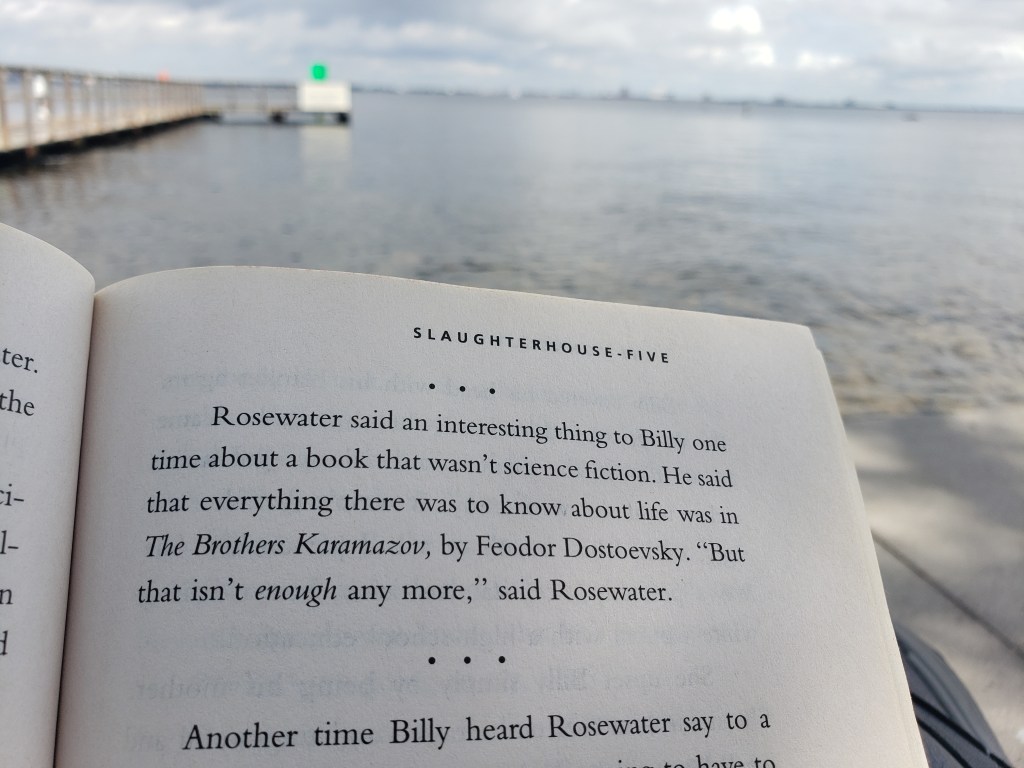
Much to my delight, The Brothers Karamazov by Fyodor Dostoevsky was referenced in this book, which happens to be one of my favorite books of all time. The quote below, that this book contained everything there was to know about life is true. I reference this in the hopes to share this work, if you have not yet had the chance to read it.
The climax of this story is the Bombing of Dresden, where our main character found himself in the basement of a slaughterhouse, “Schlachthof-fünf” to be precise. Schlachthof meant slaughterhouse. Fünf was good old five. This was the address of where he was kept, during the bombing which also saved his life. This bombing was something that I had never heard of, and if you have not heard of it either, I would encourage you to learn more about it. Those who do not learn history are doomed to repeat it.
While I would typically add the quotes from throughout the book, which I was particular fond of, I want to just add one section from the book, as not to takeaway from his unique style of writing.
- America is the wealthiest nation on Earth, but its people are mainly poor, and poor Americans are urged to hate themselves. To quote the American humorist Kin Hubbard, “It ain’t no disgrace to be poor, but it might as well be.” It is in fact a crime for an American to be poor, even though America is a nation of poor. Every other nation has folk traditions of men who were poor but extremely wise and virtuous, and therefore more estimable than anyone with power and gold. No such tales are told by the American por. They mock themselves and glorify their betters. The meanest eating or drinking establishment, owned by a man who is himself poor, is very likely to have a sign on its wall asking this cruel question: “If you’re so smart, why aint you rich?” There will also be an American flag no larger than a Childs hand-glued to a lollipop stick and flying from the cash register.
- Americans, like human beings everywhere, believe many things that are obviously untrue, the monograph went on. Their most destructive untruth is that it is very easy for any American to make money. They will not acknowledge how in fact hard money is to come by, and, therefore, those who have no money blame and blame and blame themselves. This inward blame has been a treasure for the rich and powerful, who have had to do less for their poor, publicly and privately, than any other ruling class since, say, Napoleonic times.
- Many Novelties have come from America. The most startling of these, a thing without precedent, is a mass of undignified poor. They do not love one another because they do not love themselves. Once this is understood, the disagreeable behavior of the American enlisted men in German prisons ceases to be a mystery.
I hope this has encouraged you to consider spending a few hours to enjoy this read.
So it goes…
 Perspective is key